
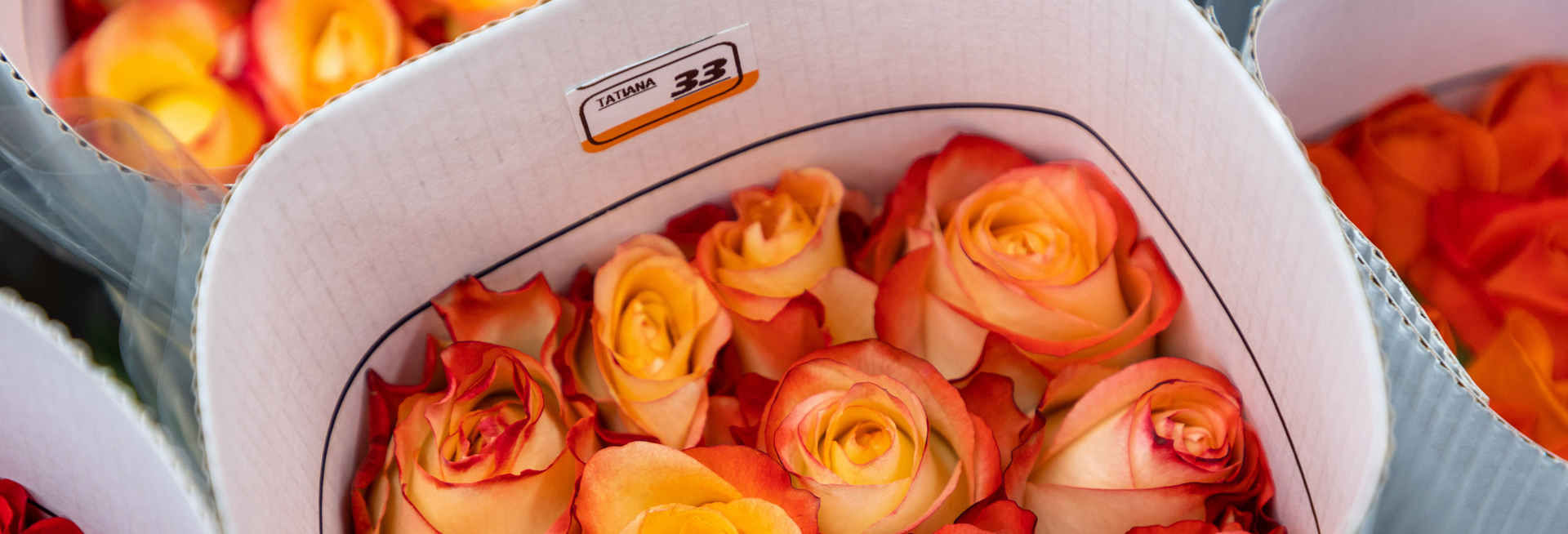

How do Ecuadorian and Netherlands-grown roses differ?
Roses linked with Ecuador and the Netherlands are both important in the international flower trade. They can differ by growing system, cultivar portfolio, grade, and route, but there is no single physical rule that identifies every rose from either origin. This guide explains what a professional buyer should compare.
Where are the roses grown?
The first distinction is the actual country and farm of production, not simply the market through which a flower was traded.
Many Ecuadorian roses are grown at elevation near the equator. Light, day and night temperatures, farm practices, cultivar, and harvest specification all influence stem and bloom development.
Roses grown in the Netherlands are commonly produced in controlled greenhouse systems where temperature, humidity, light, and crop timing can be managed. Also note that flowers sold through the Dutch trade may have been grown in another country.
Two production systems, many cultivars: compare the order specification.
Bloom size
Bloom size is one of the most visible variables, but it is determined by cultivar, grade, cut stage, and handling.
Some Ecuadorian programs offer large-bloom grades that work well in statement bouquets and event designs.
Netherlands-grown programs may offer compact or large blooms depending on the cultivar and production brief.
Stem length and strength
Ecuadorian farms offer multiple stem-length grades, including long-stem options. Confirm the exact range for each cultivar and box.
Netherlands-grown roses also vary widely by cultivar and grade; do not infer stem length or thickness from origin alone.
Opening behavior
Ask how the specified cultivar is expected to open under your receiving and care conditions.
Many Ecuadorian cultivars are selected for an expressive opening, but the result varies by variety, cut stage, temperature, and care.
Some Netherlands-grown cultivars maintain a compact form, while others open broadly. Test the actual variety for recurring programs.
Color range
Both origins offer extensive color and cultivar choices.
Ecuadorian programs include saturated, pale, bicolor, and specialty tones; request current farm photos for color-critical orders.
Dutch breeders and growers are known for broad cultivar development, and the Dutch trade is an important channel for new varieties.
Vase life
Roses from either origin can perform well when the cultivar, harvest stage, cold chain, and care are appropriate.
Origin alone does not establish a vase-life advantage. Compare documented trials under the same conditions.


A specification-led comparison
| Characteristic | Ecuadorian program | Netherlands-grown program |
| Bloom size | Varies by cultivar and grade | Varies by cultivar and grade |
| Stem length | Confirm the ordered grade | Confirm the ordered grade |
| Stem thickness | Confirm by cultivar and grade | Confirm by cultivar and grade |
| Opening | Cultivar- and care-dependent | Cultivar- and care-dependent |
| Color intensity | Confirm with current lot photos | Confirm with current lot photos |
| Vase life | Test under defined conditions | Test under defined conditions |
| Typical market use | Retail, event, and premium programs | Retail, event, and design-led programs |
Which should you choose?
There is no universal winner; start with the customer’s brief and the total delivered specification.
If a program requires long stems or a particular large-bloom Ecuadorian cultivar, request that exact farm grade.
If the brief calls for a particular breeder variety, greenhouse timing, or compact form, compare current Netherlands-grown options.
Professional florists often use roses from several origins, selecting each line for the design, season, route, and buyer requirement.
Key takeaway
You cannot reliably identify origin from bloom size, stem length, or opening alone. Verify the grower and country through traceable labels and trade documents, then assess the flowers against the agreed specification.
Ecuadorian roses remain an important option for buyers seeking specific cultivars and long-stem or large-bloom grades.
At Ecualand we source roses from partner farms in Ecuador and help clients compare varieties, grades, packing, and route-specific logistics. Availability and performance must be confirmed for each order. 🌹
Send us your requirements for a tailored year-round supply proposal
What clients say
Moscow Flowers
Floral studio
Distributor
KazakhstanChoose a consistent supply of premium Ecuadorian roses through farm-direct sourcing.
Shipping destinations
Ecualand coordinates wholesale flower sourcing and logistics for its clients.

Russia

Uzbekistan

Kyrgyzstan

Kazakhstan

Tajikistan

Guatemala

Georgia

Canada

United States


