


What affects rose vase life? Biology, handling, and logistics
What affects the vase life of Ecuadorian roses?
Vase life affects a florist’s selling window and potential waste, but fixed claims such as 14–21 days for one origin and 5–7 days for another are not meaningful without identical test conditions. Cultivar, harvest stage, farm practices, temperature history, transit, receiving, and care all interact.

Four groups of factors shape postharvest performance.
- Growing environment: one input, not a guarantee
Many Ecuadorian rose farms operate at elevation in Andean growing regions, but locations and conditions vary. Do not reduce them to one figure such as a single altitude range.
Relevant growing variables may include:
- Light intensity and how the cultivar responds under the farm’s crop-management program.
- Day-to-night temperatures which vary by farm and season and may influence growth and bloom development.
- Relatively consistent day length near the equator; production and availability can still fluctuate with weather, farm cycles, labor, and market demand.
Greenhouse roses from other regions can also perform well. A broad comparison with ‘local’ roses does not control for cultivar, grade, or handling.
- Breeding: international cultivars in Ecuadorian farm programs
Many cultivars grown in Ecuador were developed by international breeders. Farms then select programs suited to their conditions and export markets.
Depending on the cultivar and grade, buyers may specify:
- Stem strength appropriate to the chosen length, pack, and route.
- Bloom size and form matched to the customer’s design brief.
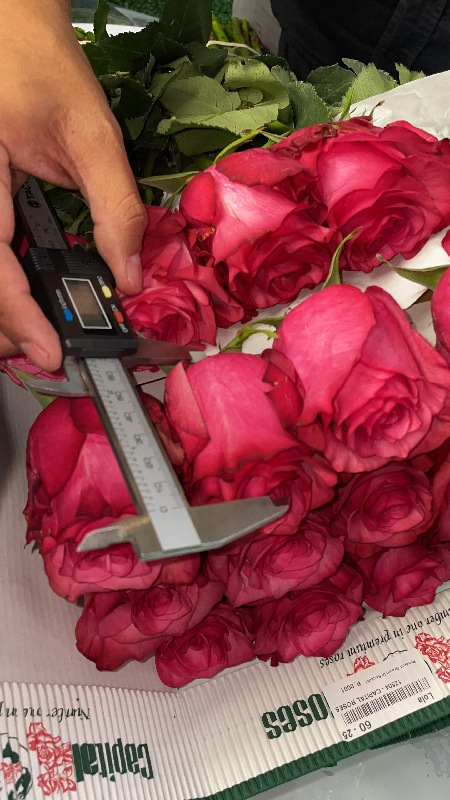
- Petal structure and condition assessed against the order specification after transit.
The cultivar Freedom shown here should be evaluated by its current breeder and farm specification, not described as a universal standard for vase life.
- Harvest and postharvest handling
Harvest timing in Ecuador is set according to the farm protocol, cultivar, cut stage, and dispatch schedule. The flower’s hydration status matters, but so does the complete postharvest process.
Relevant stages include:
- Prompt cooling using a flower- and route-specific time and temperature protocol that should be monitored rather than assumed.
- Hydration and conditioning with clean solutions and products approved for the cultivar, market, and workplace procedure.
- Final conditioning before packing using the farm’s documented protocol. Avoid unsupported claims about ‘rejuvenation’ or a universal ethylene-blocking treatment.
No treatment can make a rose look freshly cut after a fixed number of transit days under every route and handling condition.
- Comparison framework: Ecuador, Kenya, and local greenhouse programs
| Characteristic | Ecuador | Kenya | Local greenhouse program |
| Vase life | Varies by cultivar and handling | Varies by cultivar and handling | Varies by cultivar and handling |
| Stem length | Confirm the ordered grade | Confirm the ordered grade | Confirm the ordered grade |
| Bloom size | Confirm by variety and grade | Confirm by variety and grade | Confirm by variety and grade |
| Petal structure | Varies by cultivar | Varies by cultivar | Varies by cultivar |
| Transport performance | Route- and handling-dependent | Route- and handling-dependent | Route- and handling-dependent |
| Wholesale pricing | Request a current quote | Request a current quote | Request a current quote |
- Why evidence matters to the buyer
Verified postharvest performance can support:
- Lower avoidable waste when receiving, storage, and sales planning are well managed.
- A more predictable selling window when the lot has been tested under comparable conditions; it is not a reason to hold flowers without monitoring them.
- Clearer customer expectations because retailers can provide care guidance without promising that every bouquet will last a fixed number of weeks.
An Ecuadorian rose can be a strong product, but it does not guarantee margin. Evaluate landed cost, waste, demand, and verified performance together.
Send us your requirements for a tailored year-round supply proposal

What clients say
Moscow Flowers
Floral studio
Distributor
KazakhstanChoose a consistent supply of premium Ecuadorian roses through farm-direct sourcing.



How your order reaches you
Ecualand coordinates wholesale flower sourcing and logistics for its clients.
What Ecualand covers
We source from partner farms, coordinate the pre-shipment quality checks and the export documentation, and fly the order to the airport agreed with you.
What you cover
You collect the order at that airport and arrange onward transport to your own warehouse. Import clearance, duties and taxes sit with you or with the agent you appoint.
- Amsterdam: consolidated departures on Tuesday, Wednesday, Friday and Sunday. The flight is direct. Orders start at one box.
- Direct flights to other airports: from 100 kg, which is roughly four to five boxes, or 1,200 to 1,500 stems.
- Lead time: at least one week, so the prepayment clears and the airfreight space is booked. For Valentine’s Day and International Women’s Day, order from December.
- Freight: can be included when the order flies with us; otherwise the buyer arranges and pays it.
- Payment: prepayment, quoted per order in US dollars.
Tell us which airport suits you and an account manager will confirm the route, the booking window and the current price list.